How fretboard stickers work
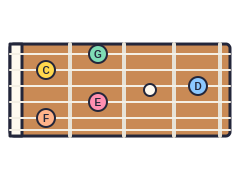
Every fret on every string plays a specific note, but beginners usually learn chord shapes without knowing which notes they're pressing. Fretboard stickers label each position, so you see that the A-minor shape contains A, C and E, or that a scale is the same pattern repeated up the neck.
They're especially useful when learning scales, moving from open chords to barre chords, finding root notes for power chords, and reading tab alongside standard notation.
The notes you'll see (standard tuning)
Standard tuning, from the thickest string to the thinnest, is E A D G B E. Each fret raises the pitch by one semitone, and the pattern repeats an octave higher at the 12th fret.
| String | Open | Natural notes at frets |
|---|---|---|
| 6th (low E) | E | F 1 · G 3 · A 5 · B 7 · C 8 · D 10 · E 12 |
| 5th (A) | A | B 2 · C 3 · D 5 · E 7 · F 8 · G 10 · A 12 |
| 4th (D) | D | E 2 · F 3 · G 5 · A 7 · B 9 · C 10 · D 12 |
| 3rd (G) | G | A 2 · B 4 · C 5 · D 7 · E 9 · F 10 · G 12 |
| 2nd (B) | B | C 1 · D 3 · E 5 · F 6 · G 8 · A 10 · B 12 |
| 1st (high E) | E | F 1 · G 3 · A 5 · B 7 · C 8 · D 10 · E 12 |
There's no sharp or flat between B–C and E–F, which is why those pairs sit just one fret apart. Everything in between is a sharp/flat — most sticker sets show these too, in a smaller font or different colour.
Choosing the right set
- Instrument and scale length. Electric, acoustic, classical, bass and ukulele necks are different lengths and widths. Buy a set made for your instrument.
- Full map vs naturals only. Full maps label every fret including sharps/flats; “naturals only” sets are cleaner and easier to read.
- Colour-coded vs plain. Colour per note helps you spot every A or every C across the neck instantly.
- Thickness. Thin vinyl decals sit under the strings without changing how the guitar feels. Avoid thick stickers that touch the strings.
- Bass guitar uses E A D G (the four lowest guitar strings). Ukulele is usually tuned G C E A — you need a ukulele-specific set.
Shop by instrument
Live listings — confirm the instrument and scale length in the description.
How to apply fretboard decals
- Loosen or remove the strings. It's much easier to place decals without strings in the way — a good moment to restring.
- Clean the fretboard. Wipe away dust and grime with a dry cloth. Let any fretboard oil dry completely — decals won't stick to an oily surface.
- Dry-fit first. Hold each decal in place to check alignment with the frets before peeling the backing.
- Start at the nut (fret 1) and work up, aligning each strip to its fret wire.
- Press firmly along each decal, then restring and tune.
Using stickers to actually learn the neck
- Week 1: find every E and A on the bottom two strings (the root strings for most barre chords).
- Week 2: say each note aloud as you play a C major scale in one position.
- Week 3: spot octave shapes — the same note two strings up and two frets higher.
- Then: cover the stickers with a strip of paper and test yourself before removing them.